As breakthroughs continue in the semiconductor advanced packaging, flexible optoelectronics and high-frequency communication industries, the supply of core monomers for high-performance photosensitive polyimide has become a critical bottleneck in the industrial chain. Recently, 2,2-bis[3-(3-aminobenzamido)-4-hydroxyphenyl]hexafluoropropane (referred to as M-6FDAP, HAFA, CAS: 220426-92-6) has achieved stable large-scale supply. It delivers a brand-new raw material solution for thermally rearranged polyimide materials and accelerates the localization of high-end fluorinated polymer materials domestically.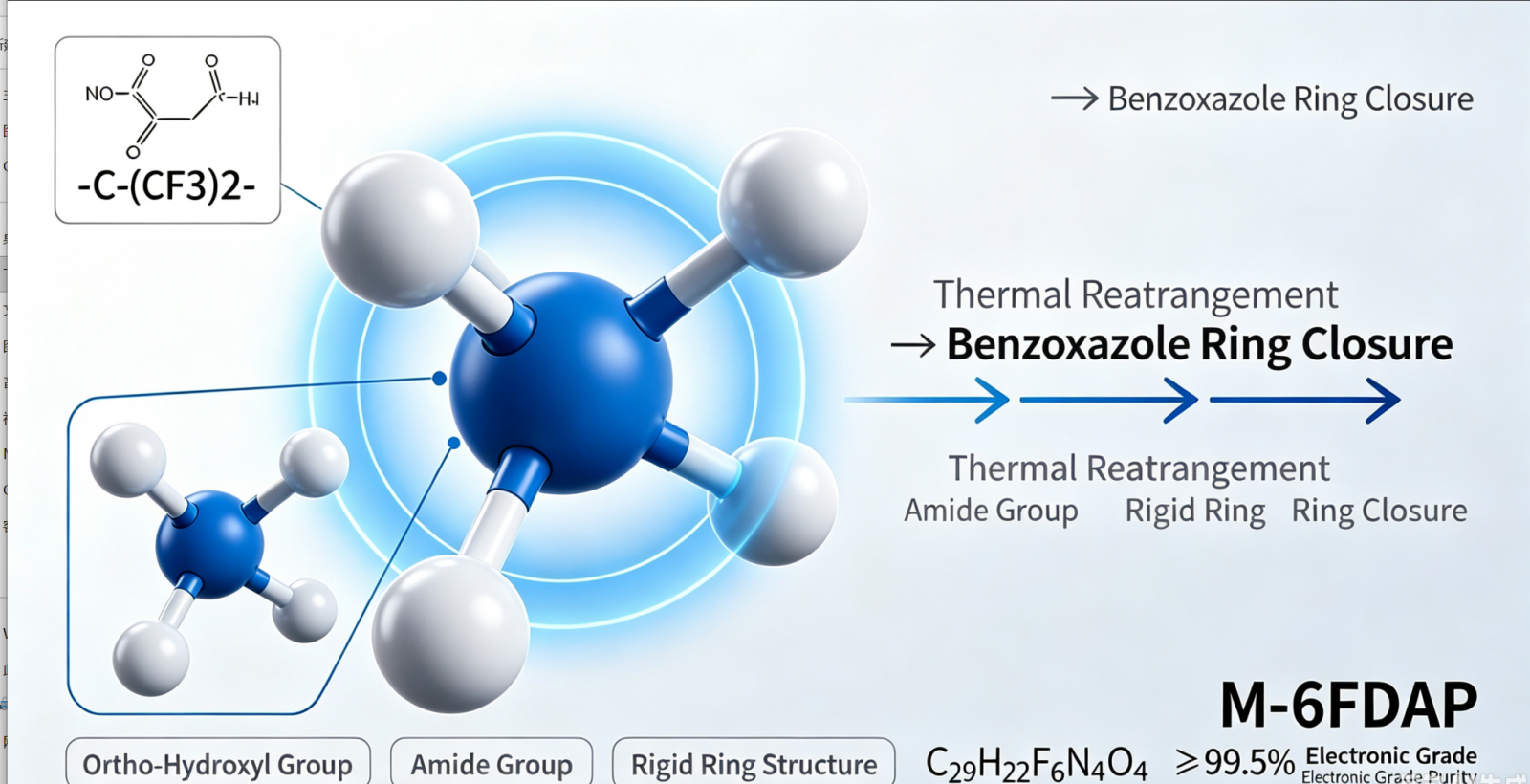
M-6FDAP is an electronic-grade fluorinated diamine monomer featuring a hexafluoroisopropylidene structure, ortho-hydroxyl groups and amide bonds. It appears as a white powder with the molecular formula C₂₉H₂₂F₆N₄O₄. Adopting refined synthesis and purification processes, the product maintains a steady purity of over 99.5%, with metal ion content controlled below 1 ppm, strictly meeting the low ionic impurity requirements for microelectronics applications. Its core technical advantage lies in its unique molecular architecture. Under high-temperature nitrogen atmosphere, the amide groups and ortho-hydroxyl groups undergo thermal rearrangement and ring closure to form rigid benzoxazole structures. This endows polymer films with ultrahigh heat resistance, low dielectric constant, low dielectric loss and outstanding chemical resistance, while retaining the photolithographic patterning capability of photosensitive polyimide. It is one of the few diamine monomers that combines photolithography processing with low high-frequency loss performance.
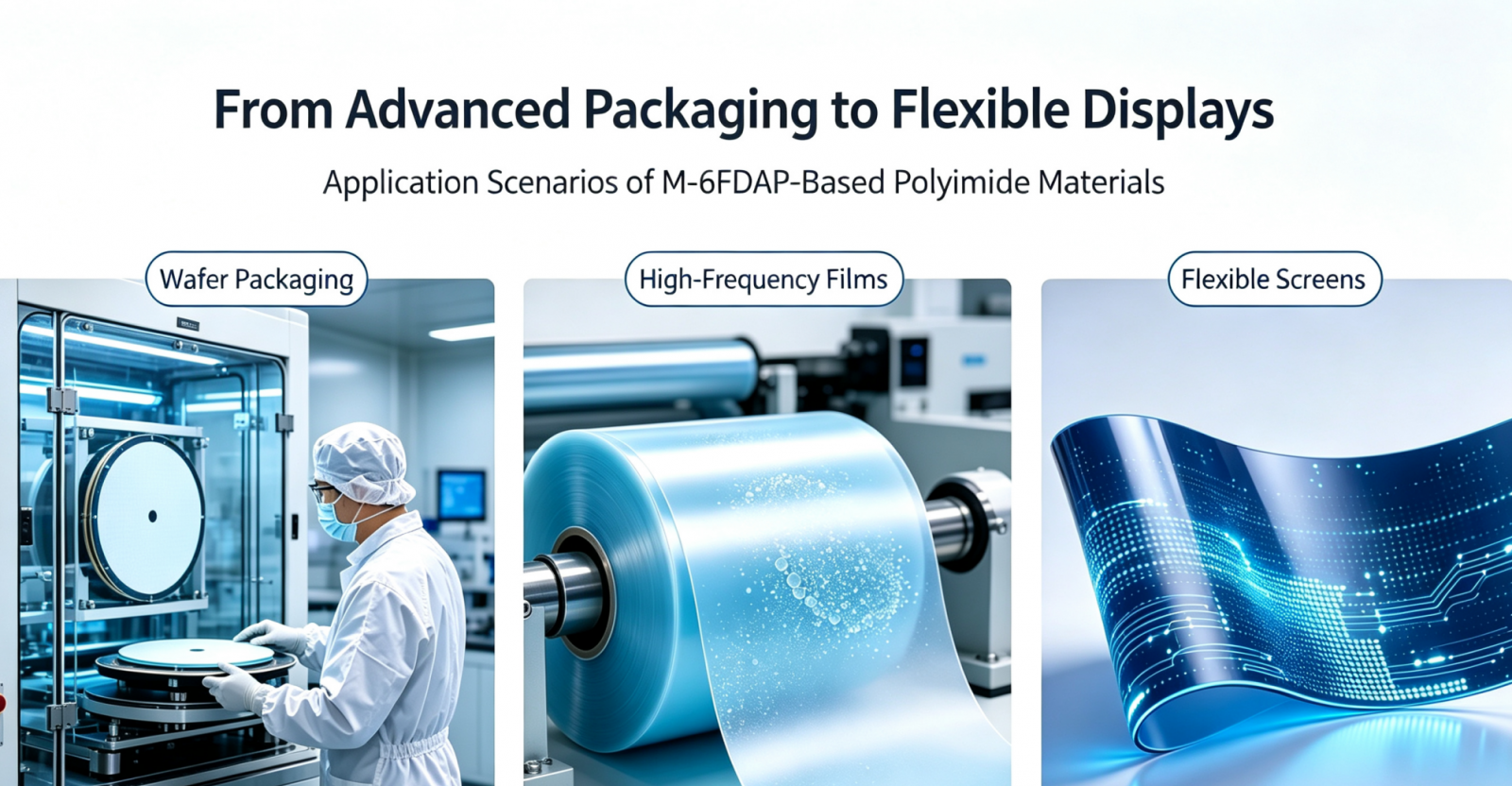
For semiconductor advanced packaging, photosensitive polyimide (PSPI) synthesized from M-6FDAP can be used for chip passivation layers, buffer coatings and RDL redistribution layer dielectric films. Featuring heat resistance, low stress and high insulation, the material is compatible with 2.5D/3D packaging processes. It maintains dimensional stability of thin films under high-temperature processes and reduces risks of device warpage and failure. For millimeter-wave high-speed communication, thermally rearranged polyimide films made from this monomer exhibit dielectric properties that are minimally affected by humidity and frequency at high frequencies. They are suitable for high-frequency flexible copper-clad laminates and high-speed signal transmission dielectric layers, addressing the high-frequency loss drawback of
conventional PI materials.
.
In the flexible optoelectronics sector, the fluorinated backbone suppresses yellowing, enabling M-6FDAP-based polyimide to fabricate high-transmittance flexible films for OLED backplanes and flexible substrates. The rigid pore structure formed after thermal rearrangement also expands the material system into high-temperature and solvent-resistant specialty separation membranes. Beyond that, this monomer can be applied in cutting-edge fields including dielectric materials for energy storage capacitors, radiation-resistant insulating coatings for aerospace, and matrices for specialty polymer adhesives, covering multiple high-value industrial chains of microelectronics, optoelectronics, energy and high-end separation materials.
From the synthesis perspective, M-6FDAP is sensitive to water and oxygen, and must be hermetically stored under low-temperature inert atmosphere. Supported by mature central-controlled synthesis, multi-stage purification and quality control systems, we offer samples for R&D as well as industrial ton-scale supply. Each batch is accompanied by COA certificates and relevant spectral data to support downstream customers in formula development, pilot scale-up and mass production alignment.
Industry insiders state that advanced polymer materials serve as the "invisible cornerstone" of semiconductors and high-end manufacturing. Stable supply of functional fluorinated diamine monomers such as M-6FDAP can effectively shorten the domestic R&D cycle of thermally rearranged photosensitive polyimide and reduce reliance on imported upstream monomers. Moving forward, the project team will continuously optimize processes to further improve batch-to-batch consistency, develop more modified polyimide and polyamide-imide material solutions, and sustain innovation and upgrading of domestic industries for advanced packaging, flexible displays and high-frequency communication materials.
Reg Office: Room 435, Building 9, No.2568 Gudai Road, Minhang District, Shanghai, China.
Pilot Lab: Building 1, No. 589 Qinling Street, Shijiazhuang High-tech Zone,Hebei, China.
Plant Unit 1: Xincheng town clean chemical park, Xinji, Hebei, China.
Plant Unit 2: Dongming County South Chemical Park, Heze City, China.
Tel: +86-21-34943721
WhatsApp:+86 186 1680 6816
Email:Massive@massivechem.com
Info@massivechem.com
Shanghai Massive Chemical Technology Co., Ltd. All Rights Reserved(C)2023 Supported by Record number:沪ICP备18008139号