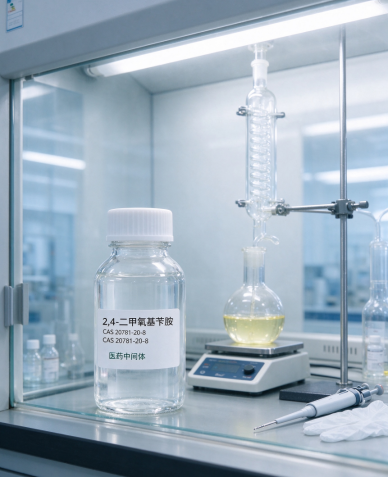
2,4-Dimethoxybenzylamine, commonly abbreviated as DMB-NH₂, CAS No.: 20781-20-8, IUPAC name: (2,4-dimethoxyphenyl)methanamine, also known as 2,4-dimethoxybenzenemethanamine. Its molecular formula is C9H13NO2 with a molecular weight of 167.21. It is a premium aromatic primary amine building block widely adopted in modern organic synthesis, solid-phase peptide synthesis (SPPS), total synthesis of natural products and R&D of anti-infective innovative drugs. At ambient temperature, it appears as a colorless to pale yellow transparent free-flowing liquid with a characteristic primary amine odor. It is readily soluble in common organic solvents including dichloromethane, THF, methanol, ethanol and ethyl acetate, while sparingly soluble in water.
The two methoxy groups at the 2- and 4-positions of the benzene ring act as strong electron-donating substituents, precisely modulating the electron density of the benzylic amino group. This structural feature delivers a distinctive reactivity profile that differentiates it from ordinary benzylamine and p-methoxybenzylamine (PMB). The amino group exhibits moderate nucleophilicity with excellent reaction selectivity and manageable side reactions. The derived DMB (2,4-dimethoxybenzyl) protecting group features mild and orthogonal deprotection conditions, making it a versatile temporary protecting unit and ammonia equivalent synthon for multi-step complex synthetic routes favoured by synthetic chemists.
In the field of protecting group chemistry, the DMB moiety represents the core value of this product and serves as a classic tool group in peptide and nucleoside synthesis. Compared with conventional benzyl (Bn) and PMB groups, DMB is more acid-labile and boasts superior orthogonality. It can be efficiently cleaved under 0 °C to room temperature using trifluoroacetic acid (TFA), p-toluenesulfonic acid or HCl in organic solvents. In a TFA/triisopropylsilane/dichloromethane system, DMB can be removed selectively while the Fmoc group remains intact. DDQ-mediated oxidative deprotection is also feasible; under properly selected conditions, Boc, tert-butyl ester and other commonly used protecting groups stay unaffected, granting remarkable flexibility for route design.
In solid-phase peptide synthesis (SPPS), DMB is specially deployed for side-chain amide nitrogen protection of asparagine and glutamine. It effectively suppresses interchain hydrogen-bond aggregation, addresses synthetic challenges for difficult hydrophobic peptide sequences, markedly reduces pyroglutamate by-product formation and improves the crude purity and yield of long peptides, cyclic peptides and modified peptides. It is also applicable to backbone amide nitrogen protection, as well as temporary masking of tetrazole, thiol and hydroxyl groups. It is extensively used in the process development of nucleosides, glycopeptides, phosphopeptides and complex modified peptides, ranking as a staple specialty protecting reagent for CROs and peptide CDMOs.
As a multifunctional nucleophilic ammonia equivalent, 2,4-dimethoxybenzylamine demonstrates irreplaceable advantages in multi-component tandem reactions. The most representative application is the one-pot Ugi/Robinson Gabriel tandem reaction for the efficient construction of 2,4,5-trisubstituted oxazole heterocyclic libraries. Oxazole skeletons are prevalent in bioactive molecules with antibacterial, anti-inflammatory, anti-tumor and agro-antibiotic properties. This tandem strategy eliminates intermediate isolation and purification, enabling convergent assembly of heterocycles, shortening synthetic sequences and lowering post-processing losses. It is highly suitable for high-throughput compound library synthesis, hit identification and structure-activity relationship (SAR) studies, supporting molecular diversity expansion on medicinal chemistry platforms.
Moreover, it functions as an amine substrate for nucleophilic addition, employed in mechanistic research on 1,4-conjugate addition of 5-bromo-2-indanone, providing a standard reaction model for the functionalization of aryl cyclic ketone skeletons. It also participates in amide condensation, imine formation, reductive amination, cycloaddition and synthesis of N-hydroxythiourea derivatives, supporting diverse C–N bond formation strategies.
In the total synthesis of natural products and novel drug candidates, this building block underpins multiple demanding synthetic routes. A landmark application is the total synthesis of (-)-Muraymycin D2 and its epimers. Muraymycin belongs to nucleoside natural products targeting bacterial cell wall biosynthesis, showing potent inhibitory activity against multidrug-resistant Gram-positive bacteria. It is a key research candidate for new non-β-lactam antibiotics. It is also used in the preparation of uridine-based polyoxin C methyl ester amide derivatives. The polyoxin family features agro-fungicidal and antiviral activities, representing hot lead compounds for green biopesticides and antiviral agents. Additionally, DMB-NH₂ is frequently introduced as a key fragment in synthetic routes for anti-HIV-1 small molecules, nucleoside anti-infective agents and novel anti-tuberculosis heterocyclic compounds. It stably shields sensitive amino groups during linear multi-step assembly and can be selectively deprotected after skeleton construction, ensuring the feasibility and scalability of total synthesis routes for complex molecules.
Beyond pharmaceutical applications, it extends downstream to fine fragrance precursors, special amino-modified resins, electronic organic additives, dye intermediates and agrochemical building blocks, continuously expanding its footprint in new material formulation development, organic methodology research and custom synthesis of specialty fine chemicals.
We supply 2,4-Dimethoxybenzylamine (CAS 20781-20-8) mainly in 98% and 99% high purity grades, with higher purity available upon custom request. Every batch undergoes rigorous quality control protocols. Analytical methods including HPLC quantitation, ¹H-NMR identification, GC, MS spectrometry, water content testing and individual impurity monitoring are implemented. Formal COA certificates are issued for each lot. Consistent batch-to-batch performance and controlled impurity profiles fully satisfy the strict requirements of academic institutes, CROs, peptide CDMOs, fine chemical manufacturers and API producers for raw material reproducibility and traceability.
Our flexible supply scope covers gram-scale samples, 5–500 g lab-scale trial batches, kilogram-level pilot runs and ton-scale industrial orders. Packaging options are diversified: fluorinated bottles and aluminum bottles for research samples, and standard 25 kg drums for bulk shipments. Neutral unbranded export packaging is available. Compliant SDS (MSDS), GHS labels and transportation identification documents are provided. We support domestic hazardous chemical logistics as well as international delivery under FOB, CIF and other trade terms. Sample delivery, synchronized technical documentation and customs declaration support are available for one-stop export service to global academic and industrial buyers.
Safety and storage notes: This product is classified as a corrosive primary amine with GHS hazard statement H314, which causes severe skin burns and eye damage. Its vapour irritates the respiratory tract. It must be hermetically sealed, protected from light and air, preferably stored under nitrogen blanket in a cool, dry warehouse. Keep away from strong acids, strong oxidants, acylating agents, heat and open flame; do not store together with acidic materials. Periodic re-inspection of colour and purity is recommended for long-term storage to avoid oxidative discoloration.
Laboratory and plant operations must be carried out in fume hoods with protective goggles, alkali-resistant gloves and face shields during transfer and charging. In case of skin or eye contact, rinse immediately with plenty of running water and seek medical attention promptly.
We provide comprehensive technical support. Our team can assist customers in evaluating feed equivalents, solvent systems, reaction temperature windows, DMB deprotection parameters, impurity prediction and workup protocols. Application guidance for peptide synthesis, heterocycle library construction and natural product route development helps customers shorten process optimization cycles and mitigate scale-up risks.
From preliminary route exploration in university research groups, high-throughput compound library construction at CROs, peptide CDMO pilot trials, total synthesis of antibiotic lead compounds, to advanced specialty material development, 2,4-Dimethoxybenzylamine (DMB-NH₂, CAS 20781-20-8) stands out as a premium fine building block balancing synthetic versatility for research and scalable manufacturability. With its unique orthogonal deprotection behaviour, stable nucleophilic reactivity and mature scaled production process, it delivers reliable raw material supply for innovative drug discovery, peptide chemistry, heterocyclic methodology and advanced fine material programmes.
FAQ for 2,4-Dimethoxybenzylamine (DMB-NH₂, CAS 20781-20-8)
A1: Full name: 2,4-Dimethoxybenzylamine. IUPAC name: (2,4-dimethoxyphenyl)methanamine. Common abbreviation: DMB-NH₂. It is also called 2,4-dimethoxybenzenemethanamine.
A2: Molecular formula: C9H13NO2; Molecular weight: 167.21.
A3: Colorless to pale yellow transparent free-flowing liquid with a characteristic primary amine odor. Soluble in DCM, THF, methanol, ethanol, ethyl acetate and other common organic solvents; sparingly soluble in water.
A4: The DMB group is more acid-labile. It features excellent orthogonal deprotection. It can be cleaved by TFA under mild conditions while Fmoc, Boc or tert-butyl ester groups remain stable. DDQ oxidative deprotection is also an alternative option. It is widely used for Asn/Gln side-chain protection in peptide synthesis to reduce by-products.
A5:
1. Solid-phase peptide synthesis (SPPS): protection of asparagine, glutamine, backbone amide nitrogen, tetrazole, thiol and hydroxyl groups.
2. Multi-component tandem reactions such as Ugi / Robinson-Gabriel reaction to build oxazole heterocyclic libraries.
3. Total synthesis of natural products, including (-)-Muraymycin D2 and polyoxin derivatives.
4. Synthesis of anti-infective, antiviral, anti-tuberculosis and anti-HIV lead compounds.
5. Organic methodology research, fine chemical precursors, specialty resin and electronic additive synthesis.
A6: Standard grades: 98% and 99%. Higher custom purity is available upon request. Each batch is tested by HPLC, ¹H-NMR, MS, water content and impurity analysis, with official COA provided.
A7: Scale: gram samples, small lab batches, kilogram pilot batches and ton-scale industrial orders. Packaging: fluorinated bottles / aluminum bottles for small samples; 25 kg standard drums for bulk. Neutral unbranded export packaging is supported. SDS, GHS labels and transport documents are supplied. FOB, CIF and other international trade terms are acceptable.
A8: Seal tightly, protect from light and air. Prefer nitrogen blanketing. Store in cool, dry warehouse. Keep away from strong acids, oxidants, acylating agents, heat and open flame. Do not store together with acidic substances. Periodic recheck is recommended for long-term storage to prevent oxidation and discoloration.
A9: GHS statement H314, causes severe skin burns and eye damage. Vapors irritate respiratory tract. All operations must be performed in a fume hood with goggles, alkali-resistant gloves and face shield. In case of contact, rinse immediately with plenty of running water and seek medical help.
A10: Yes. We can offer guidance on equivalent dosage, solvent selection, temperature window, DMB deprotection conditions, impurity control and workup procedures for peptide synthesis, heterocycle library construction and natural product synthesis routes.
A11: Yes. It has stable batch consistency, controllable impurity profile and scalable production. It meets the traceability and reproducibility requirements for CRO, peptide CDMO and API intermediate projects.
A12: Representative condition: TFA / triisopropylsilane / DCM, 0 °C to room temperature. DDQ in suitable solvent system is another oxidative deprotection route. The specific condition should be adjusted according to your substrate structure.
Reg Office: Room 435, Building 9, No.2568 Gudai Road, Minhang District, Shanghai, China.
Pilot Lab: Building 1, No. 589 Qinling Street, Shijiazhuang High-tech Zone,Hebei, China.
Plant Unit 1: Xincheng town clean chemical park, Xinji, Hebei, China.
Plant Unit 2: Dongming County South Chemical Park, Heze City, China.
Tel: +86-21-34943721
WhatsApp:+86 186 1680 6816
Email:Massive@massivechem.com
Info@massivechem.com
Shanghai Massive Chemical Technology Co., Ltd. All Rights Reserved(C)2023 Supported by Record number:沪ICP备18008139号